- All
- Product Name
- Product Keyword
- Product Model
- Product Summary
- Product Description
- Multi Field Search

Views: 222 Author: Ann Publish Time: 2025-11-10 Origin: Site


Content Menu
● Understanding the Two Core Styles: Serrated vs Straight-Edge
● Key Parameters That Drive Cutting Style and OEM Suitability
>> Blade Length
>> Handle Design and Ergonomics
>> Edge Retention and Sharpening
>> Food Safety and Certification
● Construction and Production Considerations for OEM Partners
>> Quality Control and Testing
● Maintenance, Care, and Longevity
● OEM Collaboration Roadmap: From Spec to Shipment
● Practical OEM Messaging for Marketing Pages
● Conclusion and Call to Action
● FAQ
>> How long should a Bread Knife be for typical home and professional use?
>> Can a Bread Knife be used for tasks beyond bread, such as tomatoes or cakes?
>> How should Bread Knife care and maintenance be performed to maximize edge life?
Choosing the right Bread Knife is more than picking a blade; it's selecting a tool that aligns with cutting style, bread types, and brand positioning. For foreign brands, wholesalers, and manufacturers seeking OEM partnerships, the ideal knife blends performance, durability, aesthetics, and scalable production. This article explores how to match a Bread Knife to distinct cutting styles, outlines practical design and material considerations for OEM programs, and offers actionable guidance for product development, testing, packaging, and branding.

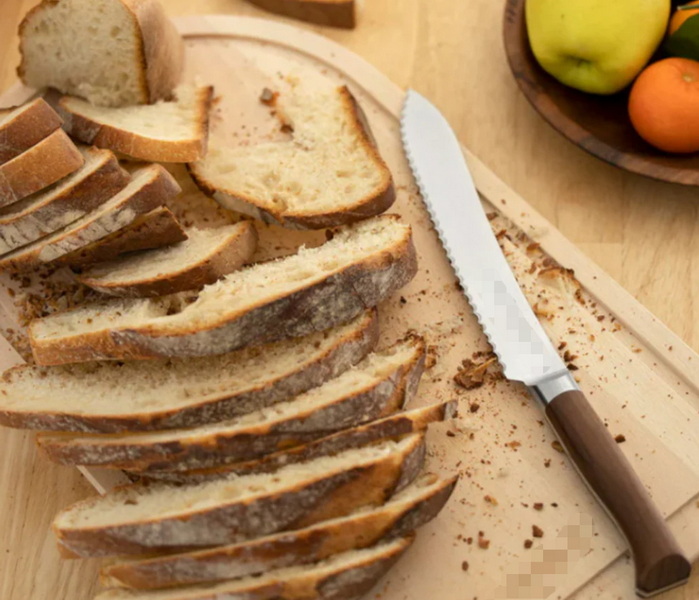
Serrated knives feature teeth that grip crust while the blade slides through the crumb. This design excels with crusty, artisanal loaves such as sourdough, baguettes, and rustic breads, where a tough exterior must be penetrated without crushing the interior. For OEM projects, serrated edges offer robust performance, long edge life, and forgiving sharpening requirements, making them appealing for mass production with consistent results. In videos, demonstrate how a serrated Bread Knife slices through a crusty loaf with minimal crumb crush, versus the same loaf cut with a non-serrated blade to highlight differences in crumb integrity.
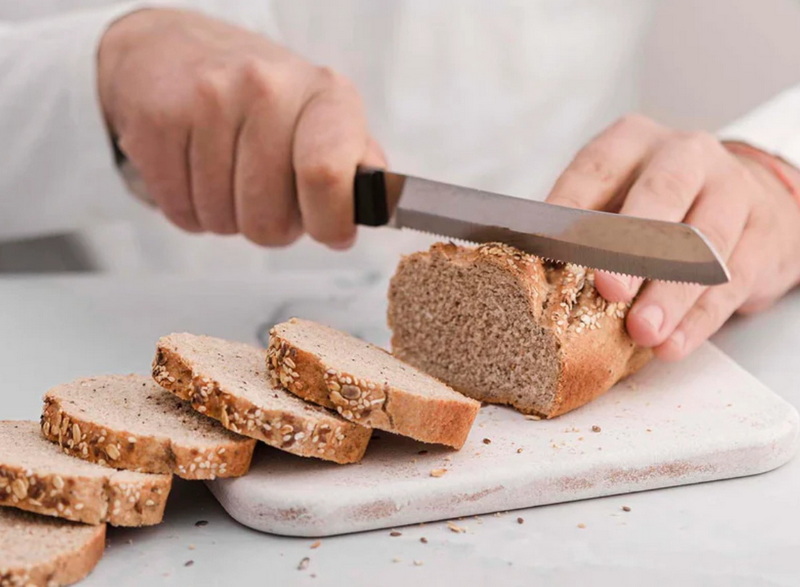
Straight-edge knives deliver clean, smooth slices on softer breads, sandwich loaves, and delicate pastries. They excel at producing uniform thickness and a neat crust-to-crumb transition, an attribute highly valued by premium brands emphasizing presentation. For OEMs, straight-edged designs necessitate precise honing and controlled blade geometry to maintain edge stability under repeated use. In demonstrations, compare slicing soft sandwich bread with a straight-edge blade against a serrated blade to show differences in slice uniformity and crumb compression.
- Bread Knives commonly range from 8 to 10 inches for home use and 9 to 12 inches in professional settings. The length influences slicing rhythm and the ability to handle larger loaves in a single stroke. OEM programs should offer a range to satisfy regional bread sizes and kitchen workflows.
- The cutting edge geometry—serrated tooth shape, density, and tip angle—determines how quickly the knife penetrates crust and how evenly it slices the crumb. OEM customization can include standard serrated patterns, scalloped edges, or hybrid tooth configurations for mixed bread types.
- Stainless steel versus high-carbon steel affects hardness, corrosion resistance, and edge retention. Coatings can reduce adhesive crumb buildup and improve hygienic cleaning, important for food-safety certifications in global markets. For OEM lines, specify material grades, heat-treatment targets, and coating options that align with brand standards and cost targets.
- Handle material (polypropylene, PEEK, or composite blends), contouring, grip texture, and balance influence cutting comfort and fatigue. OEM programs benefit from modular handle scales, color options, and branding capabilities to support multiple SKUs across markets.
- A focal point for durability is the blade's edge retention under repetitive slicing. Serrated blades typically require less frequent sharpening, whereas straight-edge blades may demand regular honing or professional sharpening. OEM suppliers should provide maintenance guides and recommended sharpening intervals tailored to consumer use.
- Materials and processing must comply with safety standards relevant to target markets (e.g., FDA/EU food-contact regulations). OEM partnerships should include documentation, third-party test reports, and traceability from raw material to finished product.
- Forged blades tend to offer superior strength and uniform grain structure, which translates to consistent performance across batches. Stamped blades can be more cost-efficient and suitable for mid-range offerings. For high-volume OEM programs, strike a balance between performance targets and cost-per-unit.
- The interface between blade tang and handle (full tang, partial tang, or hidden tang) affects durability and feel. Offer options for reinforced tangs or molded-in grippable scales to support different branding aesthetics and warranty expectations.
- Implement standardized cutting tests, edge retention evaluations, and cosmetic inspections to ensure consistent output across production runs. Provide customers with performance data sheets and QA certificates to build trust and meet procurement criteria.
- Packaging should reflect the brand's story and value proposition. Consider protective blade sheaths, color-coded rings for different models, and labeling that communicates material specs, care instructions, and warranty terms. OEM packaging should be scalable for regional markets and compliant with regulatory labeling requirements.
- Cleaning: Hand wash with mild detergent and dry immediately to prevent corrosion; avoid dishwasher exposure which can degrade coatings and handles.
- Sharpening: Serrated blades generally require professional sharpening or specialized sharpening tools; straight-edge blades benefit from regular honing and periodic sharpening.
- Storage: Use blade guards or magnetic strips to protect the edge and ensure safe handling in both consumer kitchens and professional environments.
- OEM considerations: Provide customers with maintenance schedules and warranty coverage that reflect expected usage patterns in their markets.
- Discovery: Gather customer requirements, target markets, expected monthly volumes, and preferred materials.
- Design Freeze: Present blade geometry, handle style, and packaging concepts for sign-off.
- Prototyping: Produce samples for function, safety, and aesthetic evaluation; iteratively refine based on feedback.
- Validation: Conduct performance tests (slice quality, edge retention, corrosion resistance) and safety compliance checks.
- Pilot Production: Run small-scale manufacturing to validate processes before scale-up.
- Full-Scale Production: Manufacture at the agreed weekly/monthly capacity with auditing and continuous improvement loops.
- Logistics and Aftercare: Establish packaging, labeling, and after-sales support aligned with buyer expectations and regulatory requirements.
- Emphasize “cutting style compatibility” as a core value proposition: “Designed to match your cutting style, from artisan crusts to sandwich breads.”
- Highlight material choice, durability, and ease of maintenance as a competitive edge.
- Communicate the factory's Chinese origin as a strength for cost-effective, scalable OEM manufacturing, while offering global certifications and branding support.
In choosing a Bread Knife, match the blade style to the intended cutting style, bread types, and brand philosophy. Serrated blades excel with crusty artisan loaves by delivering clean slices without crushing the crumb, while straight-edge blades shine with soft breads and delicate pastries for precise, uniform cuts. For OEM partnerships, offering a range of lengths, tooth configurations, material options, and ergonomic handles enables brands to tailor products to regional tastes and market demands. A strong OEM program includes robust QA processes, clear material certifications, scalable packaging, and a collaborative development path from concept to final product. If seeking a reliable China-based Bread Knife OEM partner, engage early with our team to discuss your specifications, request samples, review technical data sheets, and begin a tailored development plan that aligns with your brand standards and distribution strategy.
- Answer: Serrated Bread Knives are ideal for crusty or crust-dried loaves because their teeth grip the crust and slice through without crushing the crumb. Straight-edged Bread Knives excel at producing clean, even slices on soft breads and delicate pastries. For crusty artisan breads, choose serrated; for soft sandwich bread or precision slicing, choose straight-edged.
- Answer: Home kitchens typically use 8–10 inch blades, while professional settings often favor 9–12 inch blades to accommodate larger loaves. Longer blades enable fewer strokes on big loaves, but require better control—balance length with hand size and cutting space.
- Answer: Yes, serrated Bread Knives can handle tomatoes and some soft-skinned fruits; straight-edged blades are often better for cakes and pastries where a clean, smooth slice is desired. For best results, select blade geometry that aligns with the primary task, and consider blade flexibility and edge geometry.
- Answer: Hand wash with mild detergent, dry thoroughly, and avoid dishwasher exposure. Regular honing for straight-edged knives helps maintain a crisp edge; serrated blades typically require professional sharpening or specialized serrating tools at intervals. Proper storage in a blade guard or magnetic strip reduces nicks and corrosion.
- Answer: Common OEM options include blade material choice (stainless steel grades or high-carbon variants), heat treatment targets for hardness and edge retention, serration patterns or straight-edge geometry, handle materials and ergonomics, coatings to reduce residue buildup, branding on blade and handle, and packaging variations aligned with regional regulatory and marketing needs.


