- All
- Product Name
- Product Keyword
- Product Model
- Product Summary
- Product Description
- Multi Field Search

Views: 211 Author: Safina Publish Time: 2026-09-02 Origin: Saafi Kitchenware


Content Menu
● How Chinese Knife Steel Names Work
>> What Carbon Does in Knife Steel
>> What Chromium Does in Knife Steel
>> Why Molybdenum and Vanadium Matter
● Quick Comparison: 3Cr13 vs. 4Cr13 vs. 5Cr15MoV vs. 7Cr17MoV vs. 9Cr18MoV
● 3Cr13 Steel: Entry-Level Stainless for Basic Knives
>> Key Characteristics of 3Cr13 Knife Steel
>> SAAFI Manufacturing Perspective
● 4Cr13 Steel: A Practical Choice for Budget Home Kitchen Knives
>> Advantages of 4Cr13 Kitchen Knives
>> Limitations Buyers Should Understand
● 5Cr15MoV Steel: The Best Value Choice for Most Home Kitchens
>> Best Uses for 5Cr15MoV Knives
>> Sourcing Insight: Do Not Judge by Steel Name Alone
● 7Cr17MoV Steel: A Strong Option for Commercial Kitchen Use
>> Why 7Cr17MoV Works for Frequent Use
● 9Cr18MoV Steel: High Edge Retention for Premium Slicing Knives
>> The Main Benefit: Longer-Lasting Sharpness
>> The Important Tradeoff: Toughness
>> Recommended Applications for 9Cr18MoV
>> Care Guidance for End Users
● Damascus Steel: Pattern-Welded Performance and Premium Visual Appeal
>> Pattern-Welded Damascus Steel
>> Powder-Metallurgy Damascus Steel
>> How to Identify Fake Damascus Knives
>> Buyer Checklist for Damascus Knife Sourcing
● How to Choose the Right Kitchen Knife Steel
● A Better Way to Build a Knife Collection
● OEM and ODM Kitchen Knife Customization at SAAFI
● Request a Custom Knife Proposal
>> 1. Is 5Cr15MoV good for kitchen knives?
>> 2. Is 7Cr17MoV better than 5Cr15MoV?
>> 3. Is 9Cr18MoV suitable for chopping bones?
>> 4. Does a higher chromium number always mean a better knife?
>> 5. How can I tell whether Damascus steel is real?
>> 6. What is the best knife steel for a private-label kitchen knife brand?
>> 7. Why do two knives made from the same steel perform differently?
Choosing the right kitchen knife starts with understanding knife blade steel. Whether you are sourcing private-label kitchen knives, building a retail collection, equipping a restaurant, or selecting knives for home use, blade steel has a direct effect on sharpness, corrosion resistance, edge retention, toughness, maintenance requirements, and final product cost.
At SAAFI, we have manufactured and exported kitchen knives since 1994. From entry-level household knives to professional chef knives, butcher knives, cleavers, outdoor knives, handmade knives, and customized knife sets, we have seen one key sourcing lesson repeat across global markets: there is no universally "best" knife steel—only the most appropriate steel for a specific knife design, user, price point, and cutting task.
This guide compares commonly used Chinese stainless knife steels—3Cr13, 4Cr13, 5Cr15MoV, 7Cr17MoV, and 9Cr18MoV—as well as pattern-welded Damascus steel. It is designed to help importers, distributors, retailers, chefs, and brand owners make more confident decisions when developing or purchasing kitchen knives.
Many Chinese stainless steel grades use a naming format that provides a useful starting point for evaluating their composition.
For example:
- 3Cr13 generally indicates approximately 0.3% carbon and around 13% chromium.
- 4Cr13 generally indicates approximately 0.4% carbon and around 13% chromium.
- 5Cr15MoV generally indicates approximately 0.5% carbon and around 15% chromium, with molybdenum and vanadium additions.
- 7Cr17MoV generally indicates approximately 0.7% carbon and around 17% chromium, with molybdenum and vanadium additions.
- 9Cr18MoV generally indicates approximately 0.9% carbon and around 18% chromium, with molybdenum and vanadium additions.
However, the grade name alone does not guarantee final knife performance. The finished blade also depends on:
- Steel supplier consistency
- Actual chemical composition
- Heat-treatment process
- Blade thickness and geometry
- Grinding quality
- Edge angle
- Handle construction
- Intended cutting application
- Quality-control standards
In other words, two knives made from the "same" steel grade can still perform very differently. A well-designed 5Cr15MoV chef knife with controlled heat treatment may offer a better real-world user experience than a poorly ground, poorly heat-treated knife made from a higher-grade steel.
Carbon is one of the most important elements in blade steel. In general, a higher carbon content enables steel to reach a higher hardness after proper heat treatment.
Higher hardness can improve:
- Edge retention
- Wear resistance
- Fine-edge cutting performance
- Long-term sharpness under repetitive slicing
But higher hardness can also increase the risk of:
- Edge chipping
- Brittleness
- Damage from twisting or impact
- Poor performance during bone contact or heavy chopping
A hard slicing knife may stay sharp for a long time, but it is not automatically the best option for a heavy-duty cleaver. A butcher knife or bone cleaver often needs greater toughness, even if it requires more frequent sharpening.
Chromium helps stainless steel resist rust and corrosion. In general, stainless steels need sufficient available chromium to form a protective chromium oxide layer on the surface. This passive layer helps slow oxidation when the knife is exposed to water, food acids, humidity, and regular washing.
For kitchen knives, corrosion resistance matters because blades are frequently exposed to:
- Water and steam
- Acidic foods such as tomatoes, citrus, and vinegar
- Salt
- Dishwashing residue
- Humid storage environments
- Repeated washing in commercial kitchens
Still, "stainless" does not mean maintenance-free. Even highly corrosion-resistant knives should be washed, dried, and stored correctly after use.
Some steel grades include molybdenum (Mo) and vanadium (V). These alloy additions can improve aspects of hardenability, wear resistance, corrosion resistance, and carbide structure when used with suitable processing.
For practical kitchen-knife sourcing, these elements are one reason why steels such as 5Cr15MoV, 7Cr17MoV, and 9Cr18MoV are widely used for higher-value knives. But again, performance is not determined by composition alone. Heat treatment and blade design remain critical.

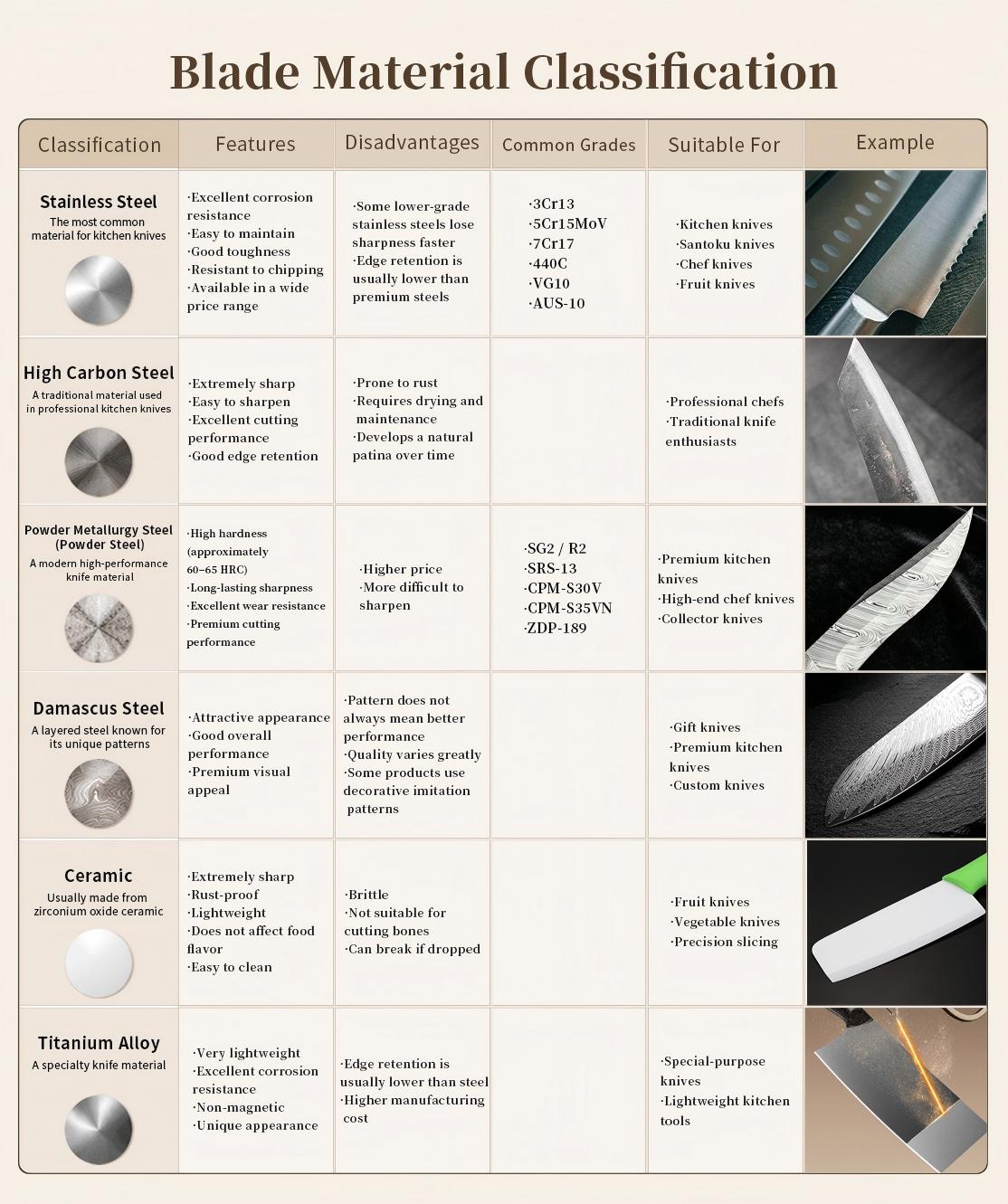
The table below provides a practical sourcing comparison. Actual hardness and performance can vary depending on heat treatment, blade thickness, edge geometry, and production standards.
| Steel Grade | Typical Market Position | Main Strengths | Main Limitations | Best Knife Applications |
|---|---|---|---|---|
| 3Cr13 | Entry-level stainless steel | Low cost, easy processing, basic corrosion resistance | Limited edge retention, requires frequent sharpening | Low-cost utility knives, basic household knives |
| 4Cr13 | Budget household knife steel | Easy sharpening, acceptable corrosion resistance, good value | Moderate hardness and limited long-term sharpness | Supermarket kitchen knives, household knife sets |
| 5Cr15MoV | Mid-range stainless steel | Balanced sharpness, toughness, corrosion resistance, value | Does not retain an edge as long as harder premium steels | Everyday chef knives, Santoku knives, household sets |
| 7Cr17MoV | Mid-to-high-range stainless steel | Better edge retention and corrosion resistance, suitable for frequent use | Requires careful grinding and heat treatment to avoid brittleness | Restaurant knives, professional prep knives, slicers |
| 9Cr18MoV | High-end stainless steel | High hardness, strong edge retention, premium positioning | Lower toughness; may chip under impact or bone contact | Fine slicers, premium chef knives, carving knives |
| Damascus steel | Premium composite or decorative category | Distinctive appearance, customization potential, high gift value | Quality varies widely; fake patterns are common | Gift knives, handmade knives, premium collections |
A key principle in metallurgy is that improving edge retention and wear resistance often reduces toughness. Higher-carbon and higher-vanadium steels may retain an edge longer, but they can become less resistant to chipping or impact damage.
3Cr13 is commonly used in low-cost knives. It can be suitable for price-sensitive projects where the buyer needs a basic stainless blade and does not expect professional-level edge retention.
- Relatively low carbon content
- Basic stainless performance
- Easy and economical to manufacture
- Usually easy for consumers to sharpen
- Lower hardness potential than higher-carbon alternatives
- Faster edge wear during frequent use
In practical use, a 3Cr13 blade may handle soft vegetables, fruit, light utility cutting, and occasional household tasks. But it is usually not the right choice for customers who expect long-lasting sharpness, fine slicing performance, or commercial-kitchen durability.
3Cr13 can still be a commercially sensible choice when used honestly and appropriately. It works best for:
- Promotional knife products
- Entry-level kitchen knife sets
- Low-cost retail channels
- Basic household utility knives
- Markets where price is the primary buying factor
For a budget knife program, blade steel should not be the only decision criterion. If using 3Cr13, we recommend improving perceived and practical value through:
- Comfortable handle ergonomics
- Clean blade finishing
- Reliable rivet or handle assembly
- Protective packaging
- Clear care instructions
- Consistent factory sharpening
A low-cost knife can still create a positive customer experience when the design, finishing, packaging, and quality consistency match the intended price point.

4Cr13 is a common choice for affordable household kitchen knives. Compared with 3Cr13, it typically offers a modest improvement in carbon content and edge performance while remaining economical and easy to sharpen.
Some manufacturers describe 4Cr13 as a classic budget kitchen-knife material because it balances cost, corrosion resistance, manufacturability, and consumer-friendly maintenance. Typical reported hardness ranges can vary, but approximately 48–53 HRC is often cited depending on heat treatment.
- Affordable material cost
- Good suitability for mass-market knife sets
- Simple maintenance for everyday users
- Reasonable corrosion resistance for home kitchens
- Easy resharpening with basic sharpeners
- Good fit for stamped or entry-level forged knife designs
The tradeoff is straightforward: a 4Cr13 knife will generally lose sharpness faster than a properly made 5Cr15MoV, 7Cr17MoV, or 9Cr18MoV knife.
For consumers who cook occasionally and are comfortable sharpening their knives, this may be entirely acceptable. For users who want prolonged sharpness with minimal maintenance, a higher-grade steel is usually a better choice.
4Cr13 is suitable for:
- Value-oriented knife blocks
- Supermarket kitchen knife collections
- Starter kitchen sets
- Basic chef knives
- Utility knives
- Paring knives
- Home-use cleavers for light vegetable cutting
It is less suitable for premium retail positioning, intensive restaurant preparation, or high-performance carving knives.

For many kitchen knife buyers, 5Cr15MoV represents the most balanced solution. It has become a popular steel for mid-range kitchen knives because it combines good corrosion resistance, useful hardness, practical toughness, and competitive pricing.
The "MoV" designation refers to molybdenum and vanadium alloy additions. In knife applications, these additions can support better hardenability and wear resistance when combined with sound heat treatment and finishing. A composition reference for 5Cr15MoV commonly lists approximately 0.45–0.50% carbon and 14.5–15.0% chromium.
A well-made 5Cr15MoV knife can offer a strong everyday balance:
- Good cutting sharpness
- Good corrosion resistance
- Better edge retention than entry-level steels
- Better toughness than harder premium steels
- Reduced risk of chipping during normal kitchen work
- Accessible pricing for retail and private-label programs
This makes it especially suitable for consumers who want a noticeable step up from basic supermarket knives without moving into a premium price category.
5Cr15MoV is a strong option for:
- Home chef knives
- Santoku knives
- Bread knives
- Utility knives
- Carving knives
- Kitchen knife blocks
- Gift-ready knife sets
- Mid-range retail brands
- OEM and ODM knife programs
When evaluating 5Cr15MoV knives from suppliers, request more than a material claim. Ask for:
1. Declared blade hardness range in HRC.
2. Heat-treatment method and process controls.
3. Blade thickness at spine and cutting edge.
4. Edge angle and sharpening standard.
5. Salt-spray or corrosion testing, if relevant to your market.
6. Handle pull-force and assembly testing.
7. Packaging drop-test standards for e-commerce shipments.
8. Sample approval before mass production.
For brand owners, these details often determine whether a knife generates repeat purchases and positive reviews—or creates returns due to dullness, rust complaints, loose handles, or edge damage.
7Cr17MoV moves into a more performance-oriented category. With higher carbon and chromium content than 5Cr15MoV, it can provide stronger edge retention and corrosion resistance when properly heat treated.
For hotel kitchens, restaurants, catering operations, food-preparation facilities, and serious home cooks, this steel can offer a compelling balance of durability and cutting performance.
Commercial kitchens place knives under more demanding conditions:
- Long preparation shifts
- Repeated cutting cycles
- Frequent washing
- Contact with acidic ingredients
- Fast-paced handling
- Multiple users with different skill levels
In these environments, a knife must remain sharp enough for efficient preparation while resisting corrosion and maintaining a reliable edge.

- Better long-term sharpness than many mid-range steels
- Strong corrosion resistance
- Suitable for thin, efficient cutting edges
- Good option for professional food preparation
- Supports premium positioning without the highest material cost
- Works well in chef knives, slicing knives, and carving knives
7Cr17MoV is not automatically ideal for every blade shape. For example:
- A thin chef knife can benefit from its sharper, more wear-resistant edge.
- A slicing knife can take advantage of longer edge retention.
- A heavy cleaver may require a tougher geometry and more conservative heat treatment.
- A bone cleaver should prioritize impact resistance over ultra-high hardness.
The right choice depends on the final blade profile, thickness, cutting angle, intended user, and target market.
9Cr18MoV is often positioned as a higher-end stainless knife steel within this family. With higher carbon and chromium content, it can achieve greater hardness and stronger edge retention than lower-numbered Cr-series steels when heat treated correctly.
Some market references describe 9Cr18MoV as having potential hardness in the approximate 58–62 HRC range, though the actual result depends on the manufacturer's heat-treatment process.
A properly manufactured 9Cr18MoV blade can be attractive to users who value:
- Long intervals between sharpening
- Fine slicing performance
- Strong wear resistance
- Premium product positioning
- A thinner, sharper cutting edge
This steel is particularly suitable for premium chef knives, carving knives, meat slicers, and precision-cutting kitchen tools.
The same hardness that improves edge retention can make a blade more sensitive to impact. High-hardness knives are more likely to chip if used incorrectly, especially when they contact:
- Bones
- Frozen food
- Ceramic plates
- Glass cutting boards
- Metal surfaces
- Hard shells
- Other knives in a sink
For this reason, 9Cr18MoV is generally better suited to slicing and precision food preparation than aggressive bone chopping.
- Premium chef knives
- Japanese-style kitchen knives
- Carving knives
- Slicing knives
- Premium meat knives
- High-end gift collections
- Enthusiast-focused knife brands
A premium knife should include clear care instructions:
- Hand wash after use.
- Dry immediately with a soft cloth.
- Do not place in a dishwasher unless specifically designed and tested for it.
- Use wood, soft plastic, or rubber cutting boards.
- Avoid bones, frozen food, and hard surfaces unless the knife is designed for those tasks.
- Store in a knife block, sheath, magnetic holder, or protective sleeve.
- Sharpen using a compatible whetstone, honing system, or professional service.
These instructions help protect the blade and reduce avoidable warranty claims.
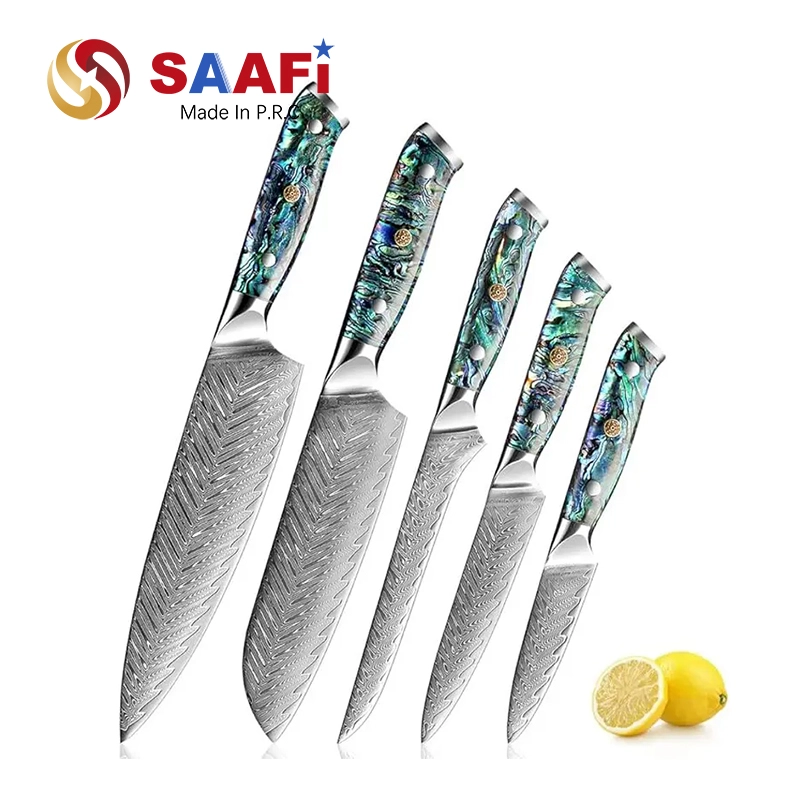
Damascus steel kitchen knives occupy a different category from single-steel blades. In modern knife manufacturing, the term usually refers to a layered material made by forge-welding two or more steels together, then manipulating and etching the layers to reveal a flowing pattern.
For consumers, Damascus often represents craftsmanship, uniqueness, premium gifting, and visual distinction. For brand owners, it can support higher retail pricing and stronger shelf appeal.
Traditional modern pattern-welded Damascus is created by combining multiple steels in layers. The billet may be folded, forged, twisted, cut, stacked, ground, and acid-etched to create visible patterns.
Common patterns include:
- Raindrop
- Ladder
- Twist
- Feather
- Wave
- Floral or custom pattern designs
Each blade can have a distinctive appearance because the pattern is formed by the actual layered structure, not simply printed onto the surface.
Premium Damascus can also be created using powder-metallurgy technologies. These materials can offer highly refined structures and advanced performance, but they are significantly more expensive and typically used for high-end enthusiast, collector, or luxury knife products.
For most commercial kitchen knife projects, a well-produced pattern-welded Damascus blade with a suitable stainless core can offer a more realistic balance between appearance, performance, and cost.
One of the most common sourcing risks is decorative "Damascus" that uses a surface pattern rather than genuine layered steel.
Warning signs can include:
- A repetitive printed-looking pattern
- An unusually low price for a supposed hand-forged Damascus knife
- Patterns that disappear with wear
- A pattern that does not continue across the spine or blade edge
- Identical markings across many supposedly handmade blades
- No material documentation from the supplier
A genuine pattern-welded Damascus blade has structural layers within the steel. Sources discussing fake Damascus note that superficial patterns may rub off or disappear after polishing, while authentic layered patterns can reappear after appropriate refinishing and etching.
Before placing a Damascus knife order, ask your supplier:
1. What steels are used in the blade layers?
2. What is the core steel, if the knife uses a layered cladding structure?
3. Is the blade pattern-welded, laser-marked, printed, or chemically surface-etched?
4. How many layers are used?
5. What hardness range is targeted after heat treatment?
6. Does the pattern extend visibly across the spine and edge?
7. Can the supplier provide factory process images or production documentation?
8. Can you inspect and approve a physical pre-production sample?
The correct steel depends on how the knife will be used, who will use it, the expected retail price, and how much maintenance the customer accepts.
- Your target is the lowest possible product cost.
- The knife is intended for occasional light household use.
- The buyer prioritizes price over long-term sharpness.
- You need an entry-level promotional or value product.
- You need a practical knife for budget home kitchens.
- Easy sharpening is important.
- You are producing mass-market knife sets.
- You need reliable value for supermarket or entry retail channels.
- You want the best all-around value for household kitchen knives.
- Your customers expect good sharpness, reasonable toughness, and good rust resistance.
- You are developing a mid-range knife set or branded chef knife.
- You need a reliable steel for broad international retail appeal.
- You are targeting restaurant, hotel, catering, or frequent-use kitchen environments.
- Longer edge retention is important.
- You want a more premium stainless-steel product.
- The knife will be used mainly for slicing, prep work, and general professional kitchen tasks.
- You are developing a premium slicing, carving, or chef knife.
- Your buyer wants longer edge retention.
- Your design prioritizes precision cutting and a finer edge.
- Your customer understands that hard blades require careful use.
- Your brand needs a premium visual story.
- You are developing a high-value gift knife.
- Handmade craftsmanship is part of your product positioning.
- Your customers value distinctive patterns and collectible appeal.
- You can verify the material construction and production process.
Rather than using one steel grade for every knife, serious brands and professional kitchens can benefit from matching blade design to cutting task.
For example, a practical kitchen collection could include:
| Knife Type | Recommended Steel Direction | Why It Works |
|---|---|---|
| Everyday chef knife | 5Cr15MoV or 7Cr17MoV | Balanced durability, sharpness, and corrosion resistance |
| Heavy vegetable cleaver | 5Cr15MoV with tougher geometry | Better resistance to repetitive chopping forces |
| Meat slicing knife | 7Cr17MoV or 9Cr18MoV | Stronger edge retention for clean slicing |
| Bone cleaver | Tougher steel and thicker blade design | Better impact resistance than ultra-hard thin blades |
| Gift or premium display knife | Genuine Damascus steel | Strong visual differentiation and premium appeal |
| Budget knife set | 4Cr13 | Cost-effective for basic household use |
This approach reduces customer dissatisfaction because each knife is designed around its actual job.
A common mistake is promoting every knife as "ultra-hard" or "all-purpose." In reality, a knife designed for fine slicing should not be marketed as a bone-chopping tool. Clear product positioning protects the consumer, supports better reviews, and helps brands reduce returns.
At SAAFI, we support OEM and ODM kitchen knife projects for importers, wholesalers, retailers, e-commerce sellers, restaurant suppliers, and private-label brands.
Our customization options can include:
- Knife blade shape and size
- Blade steel selection
- Blade thickness and grinding style
- Blade finish, such as satin, mirror, stonewashed, or patterned finish
- Handle material selection
- Wood, plastic, stainless steel, G10, resin, or composite handle options
- Handle color and ergonomic design
- Laser logo, etched logo, stamped logo, or printed branding
- Knife block, sheath, gift box, blister card, color box, or customized packaging
- Knife sets and accessory combinations
- Product photography and packaging development support
- Pre-production sampling and quality inspection processes
For international buyers, the most successful knife projects usually begin with a clear product brief: target market, retail price, user profile, knife style, material expectations, packaging requirements, and compliance needs.
Before requesting a quotation, prepare the following information:
1. What knife type do you need: chef knife, cleaver, butcher knife, carving knife, outdoor knife, or knife set?
2. What is your target market: North America, Europe, the Middle East, Southeast Asia, or another region?
3. What retail price range are you targeting?
4. Do you need a budget, mid-range, or premium positioning?
5. Which blade steel best fits your expected performance?
6. What handle material and visual style fit your brand?
7. Do you require custom packaging and branding?
8. What quantity do you expect for sampling and mass production?
The clearer the brief, the more efficiently a manufacturer can recommend the right steel, blade geometry, handle construction, packaging solution, and quality-control plan.
The best kitchen knife steel is not simply the steel with the highest number, the highest hardness, or the most dramatic Damascus pattern. The right choice is the one that balances performance, durability, maintenance, user expectations, and cost for the intended application.
For many everyday kitchen knife programs, 5Cr15MoV offers the strongest overall value. For commercial preparation and more demanding use, 7Cr17MoV is often a strong upgrade. For premium slicing knives where long edge retention is the priority, 9Cr18MoV can be an excellent option when used correctly. For high-end gifts, handmade collections, and visual differentiation, genuine pattern-welded Damascus steel offers a compelling premium story.
SAAFI combines decades of knife manufacturing experience with product development, quality control, export support, and OEM/ODM customization. From a single private-label chef knife to a complete kitchen knife collection, we can help you select the blade steel and product configuration that fit your market.
Looking for a reliable kitchen knife manufacturer for your next OEM or ODM project?
Share your target knife type, preferred blade steel, handle material, logo requirements, packaging concept, target quantity, and destination market. The SAAFI team can help you develop a kitchen knife solution that aligns with your product positioning, performance expectations, and commercial goals.
Yes. 5Cr15MoV is a strong all-around choice for many kitchen knives. It offers a practical balance of corrosion resistance, edge retention, toughness, sharpenability, and manufacturing cost. It is especially suitable for mid-range household chef knives, Santoku knives, utility knives, and knife sets.
7Cr17MoV can offer better edge retention and corrosion resistance because it generally contains more carbon and chromium. However, it may be less forgiving under impact than 5Cr15MoV. The better choice depends on the knife design and use case: 5Cr15MoV is excellent for versatile everyday kitchen use, while 7Cr17MoV suits more frequent or professional preparation work.
Generally, no. 9Cr18MoV is better suited to slicing, carving, and fine cutting because its higher hardness supports better edge retention. Heavy contact with bones, frozen food, ceramic plates, or hard surfaces can increase the risk of edge chipping. For bone chopping, choose a dedicated, thicker, tougher cleaver.
No. Higher chromium can support stronger corrosion resistance, but knife quality also depends on carbon content, heat treatment, blade geometry, grinding, handle construction, and quality control. A well-made knife using a balanced mid-range steel can outperform a poorly manufactured knife using a more expensive steel grade.
Ask the supplier about the steels used, layer construction, heat-treatment process, and whether the blade is pattern-welded. Visually, genuine Damascus patterns commonly continue over the blade spine and may be visible at the cutting edge. Be cautious of extremely inexpensive "Damascus" knives, repeating printed patterns, or patterns that wear away. Genuine layered Damascus is structurally different from a surface-only decorative pattern.
For broad consumer appeal, 5Cr15MoV is often a very practical option because it provides a good balance of cost and performance. For a more premium commercial or professional line, 7Cr17MoV may be more suitable. For a premium enthusiast-focused slicer, 9Cr18MoV can support stronger edge-retention claims when paired with proper care instructions.
Steel grade is only one part of knife performance. The final result also depends on heat treatment, blade hardness, edge angle, blade thickness, grinding precision, handle assembly, and the manufacturer's quality-control standards. This is why factory experience and process consistency matter as much as the steel label.
1. Benchmade. "Blade Steel 101." Explains edge retention, corrosion resistance, and the role of chromium in stainless blade steels. [https://www.benchmade.com/blogs/beyond-the-bench/blade-steel-101] [benchmade]
2. Knife Steel Nerds. "Toughness, Edge Retention, and Corrosion Resistance." Provides metallurgy-based analysis of the tradeoffs between toughness, wear resistance, edge retention, and corrosion resistance in knife steels. [https://knifesteelnerds.com/2021/10/19/knife-steels-rated-by-a-metallurgist-toughness-edge-retention-and-corrosion-resistance/] [knifesteelnerds]
3. ZKnives. "Composition Comparison Graph for GB 3Cr13, 5Cr15MoV, 7Cr17MoV and 9Cr18MoV." Provides comparative chemical composition data for commonly used Chinese knife steels. [https://zknives.com/knives/steels/steelgraph.php?nm=+5cr15mov,+7cr17mov,+9cr18mov,3cr13] [zknives]
4. Knives Ranch. "Pattern-Welded Damascus Steel Explained." Explains how modern pattern-welded Damascus is made through forge-welding and manipulating multiple layers of steel. [https://www.knivesranch.com/blog/pattern-welded-damascus-steel-explained] [knivesranch]
5. Knife Depot. "How to Tell Real Damascus Steel Knives vs. Fake Blades." Discusses common warning signs of false Damascus patterns and methods used to distinguish surface decoration from layered steel. [https://blog.knife-depot.com/how-to-tell-real-damascus/] [blog.knife-depot]
6. Zhang Xiaoquan Australia. "Understanding 4Cr13 Steel: The Budget-Friendly Option for Kitchen Knives." Provides reference information on 4Cr13 hardness and comparison points with 5Cr15MoV and 9Cr18MoV. [https://zhangxiaoquan.au/blogs/kitchen-knife-steel/understanding-4cr13-steel-the-budget-friendly-option-for-kitchen-knives] [zhangxiaoquan]
7. Knife Informer. "Knife Steel Composition Chart: Building Blocks." Provides knife-steel composition information, including reference values for 5Cr15MoV. [https://knifeinformer.com/knife-steel-composition-chart/] [knifeinformer]


