- All
- Product Name
- Product Keyword
- Product Model
- Product Summary
- Product Description
- Multi Field Search

Views: 222 Author: Ann Publish Time: 2025-11-25 Origin: Site


Content Menu
● What is MOQ and Why Is It Set?
● Benefits of Low MOQ for Buyers
● Advantages for Manufacturers Offering Low MOQ
● Design and Customization Flexibility
● Cost Implications of Low MOQ
● Choosing Manufacturers with Low MOQ
● Cheese Knife Manufacturing Process and OEM Services
● Quality Control and Certifications
● Customization Options for Cheese Knives
● Marketing Advantages of Low MOQ
● FAQs About Ordering Cheese Knives with Low MOQ
>> 1. What does MOQ mean in cheese knife manufacturing?
>> 2. Why is a low MOQ advantageous for small businesses?
>> 3. Is customization possible with low MOQ?
>> 4. Does low MOQ increase unit cost?
>> 5. How can I find reliable cheese knife manufacturers with low MOQ?
Ordering cheese knives from manufacturers involves many crucial factors, with Minimum Order Quantity (MOQ) standing out as one of the most significant. In the competitive kitchenware market, manufacturers providing low MOQ options offer invaluable advantages for startups, small businesses, and established brands wanting to experiment with new products. Low MOQ increases flexibility, reduces financial risk, and enables customization. This article provides an in-depth analysis of why low MOQ matters when sourcing cheese knives and practical guidance for buyers.

MOQ refers to the minimum number of units a manufacturer requires per order to justify production costs. These costs include raw materials, labor, production setup, packaging, and logistics. For example, a kitchen knife factory may require a MOQ of 500 cheese knives to cover these expenses efficiently. While this number suits large buyers, it can be a barrier for smaller businesses or those testing market response. Thus, the option for low MOQ becomes critical to reduce entry barriers and foster innovation.
- Reduced Financial Risk: Small order quantities lower upfront investment and the risk of unsold stock.
- Market Responsiveness: Buyers can react faster to market trends, seasonal demands, or customer feedback with the agility of smaller orders.
- Cost-Effective Inventory Management: Less inventory means lower warehousing and holding costs.
- Accessibility for Small Businesses: Startups or niche brands with limited capital can source premium cheese knives affordably.
- Expanded Market Reach: Catering to small brands and startups broadens the customer base.
- Streamlined Inventory: Smaller production runs reduce storage costs and obsolescence risks.
- Long-Term Client Relationships: Repeat small orders build lasting partnerships.
Cheese knives often require distinct customizations—handle materials, blade shapes, packaging, and branding—to fit different market niches. Low MOQ allows buyers to experiment with these customizations in economically manageable batches, reducing risks from extensive inventory and allowing market testing before scaling.
The cost per unit is generally higher with low MOQ because economies of scale are less attainable. However, when factoring in savings from reduced inventory, storage, and minimized waste, the total cost of ownership can be lower. Buyers should assess these factors comprehensively when selecting their production scale.
- Seek OEM factories specializing in kitchen knives, verified by certifications like BSCI, LFGB, and FDA for quality and food safety.
- Confirm that manufacturers allow small batch orders and support OEM customization.
- Request samples to assess quality and production timelines.
The manufacturing process for cheese knives combines precision, quality control, and customization to meet specific buyer requirements. The journey begins with product design, where professional designers create detailed drafts or 3D printed prototypes for buyer evaluation. This step is crucial for ergonomic handle design, blade shape, and material selection, often varying depending on cheese types (soft vs hard).
After design approval, the production moves into steel cutting and blade profiling using automated machines or skilled craftsmanship. The blade undergoes drilling for handle assembly pins and weight reduction, followed by heat treatment (hardening). This ensures durability and edge retention. Next, multiple grinding and polishing stages refine the blade to sharpness and finish standards.
Handles, made from wood, resin, or composites, are precision-attached using adhesives and mechanical fasteners, then ergonomically shaped and polished. Throughout the process, stringent quality controls inspect material conformity, blade hardness, sharpness tests, and final product inspections.
OEM manufacturers typically offer one-stop service that includes product and packaging design, sample approval, production, inspection, and logistics. They maintain open communication during production runs to ensure buyers' specifications are precisely met. Factories with low MOQ policies can facilitate smaller production batches, enabling clients to test market acceptance without large upfront commitments.
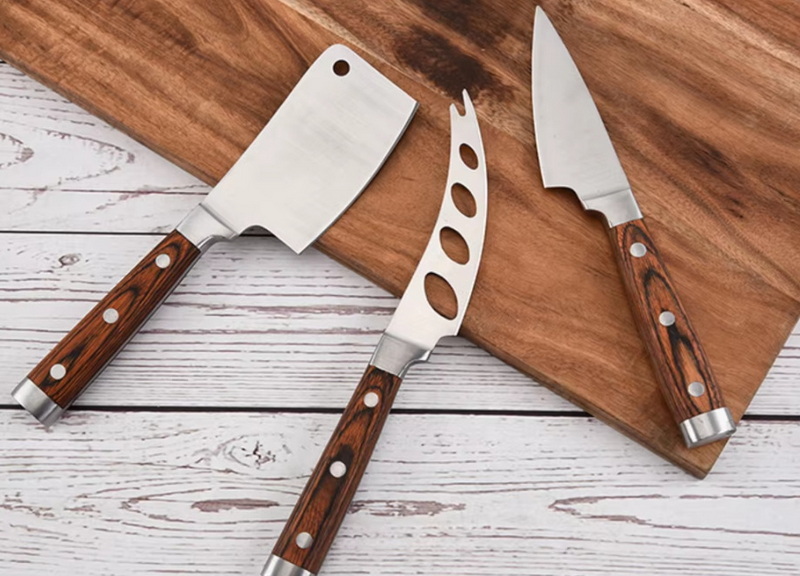
High standard cheese knives must comply with strict quality and safety standards in materials and production methods. Reputable OEM manufacturers implement rigorous quality control at every stage, including raw material testing, process monitoring, and final product checks. Certifications such as LFGB and FDA food contact safety tests ensure knives are safe for kitchen use.
Low MOQ buyers benefit by receiving small batch runs tested for quality, minimizing losses due to defects. Transparent quality assurance helps build confidence in the products before scaling up production.
Customization is a major selling point in the cheese knife market. Buyers can customize:
- Blade style (e.g., forked tip, perforated blades for soft cheese)
- Handle materials (wood, plastic, resin, stainless steel)
- Engraving or laser etching of logos
- Packaging design (gift boxes, blister packs)
Low MOQ orders allow experimentation with these custom features on a small scale. Testing different models and packaging versions is cost-effective and minimizes waste.
Small order sizes provide marketers the freedom to launch limited editions or seasonal products to maintain consumer interest. Quick adaptation to customer feedback or emerging trends without being tied down by large inventory is invaluable for competitive advantage. Lower MOQ supports agile strategies to differentiate cheese knife offerings in a crowded marketplace.
Ordering smaller quantities aligns with sustainable business practices by reducing overproduction and waste. Environmental concerns make it increasingly important to optimize manufacturing runs. Low MOQ manufacturing helps reduce carbon footprint and resource consumption by matching supply more accurately with actual demand.
- A startup artisan cheese knife brand can afford to order 100 customized knives with unique handles and packaging, testing market response before increasing orders.
- A retailer can introduce seasonal designs or limited edition series without large inventory costs.
- Established brands can pilot novel ergonomic designs or new materials for cheese knives with minimal financial exposure.
Choosing manufacturers with low MOQ when ordering cheese knives offers significant advantages including financial flexibility, customization options, market responsiveness, and risk mitigation. Small batch capacities empower businesses of all sizes to innovate and adapt quickly in competitive kitchenware sectors. For manufacturers, offering low MOQ expands market access and fosters dependable client partnerships. Leveraging low MOQ strategically is a smart move in today's evolving kitchenware landscape.
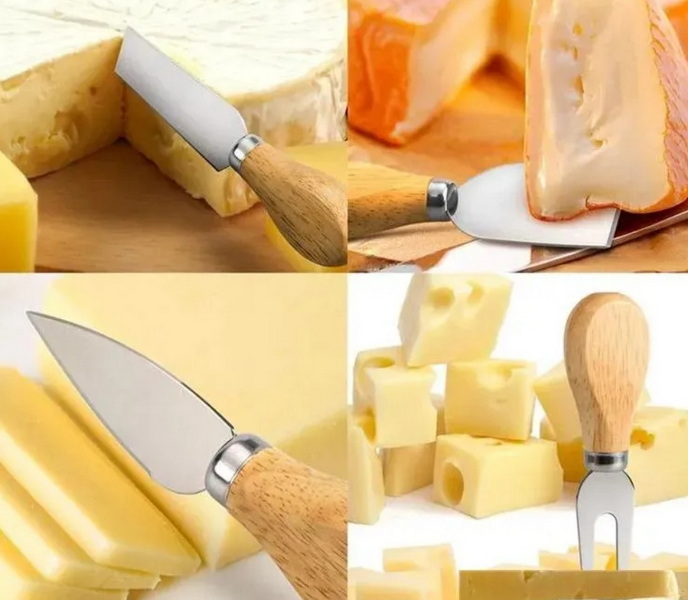
MOQ is the minimum number of cheese knives a manufacturer requires per order to cover production and setup costs.
It reduces upfront investment and inventory risk, making it feasible for small brands to enter the market.
Yes, many OEM manufacturers provide full customization options—even for small orders.
Typically, yes, but overall savings on storage, waste reduction, and market testing often outweigh higher unit prices.
Research certified OEM factories, request samples, verify MOQ policies, and check client feedback before ordering.


